A practical TI guide for tenants, owners, and project teams who don’t want permitting to eat the schedule.
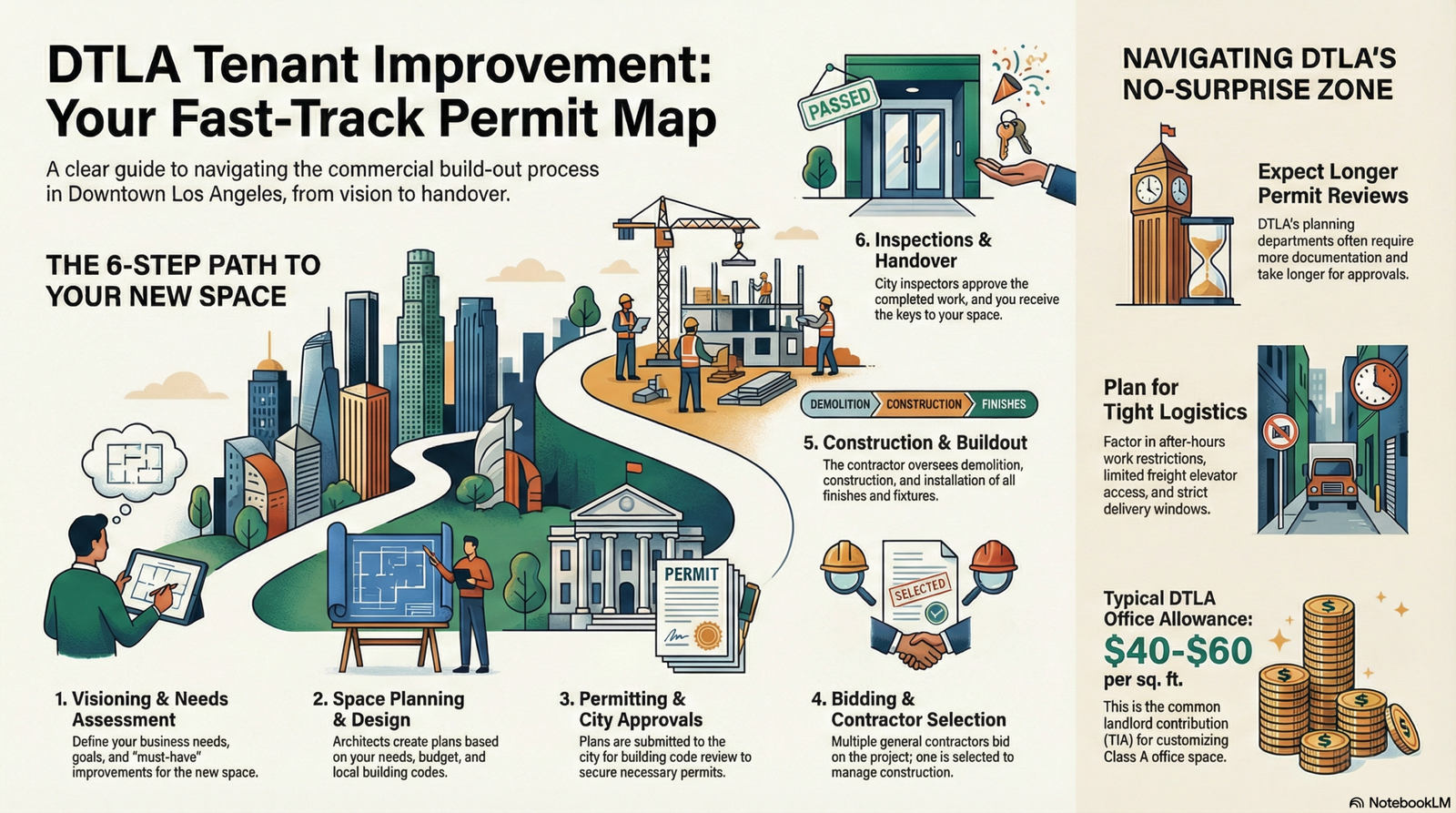
Downtown Los Angeles is a different animal. You can have a clean lease, a solid design, and a great contractor… and still lose weeks because somebody didn’t think through building access, plan check lane selection, or the “one missing document” that triggers corrections.
This article is your field guide: how the City side works, what DTLA adds to the mix, and how to keep your TI moving without living at the counter.
The DTLA permit reality: three clocks are always running
On a TI, you’re managing three clocks at once:
-
Lease clock (rent starts / free rent ends / opening date)
-
Permit clock (submittal → plan check → corrections → approval → issuance)
-
Construction clock (procurement → build → inspections → final signoff)
If you treat permitting like “paperwork we’ll do later,” DTLA will punish you.
Step 1: Know what “needs a permit” (before you design the wrong thing)
In Los Angeles, LADBS is the hub for permits and inspections. Most TI scopes touch multiple permit types (building + MEP), and if you guess wrong you’ll bounce between reviewers.
LADBS’s plan review/permitting page lays out the permit categories (Building, Electrical, Mechanical HVAC, Plumbing, etc.) and the plan review pathways you’ll likely fall under.
Rule of thumb:
-
Cosmetic-only work can sometimes stay simple.
-
The moment you’re moving walls, changing exiting, touching HVAC/electrical/plumbing, changing use, or doing anything accessibility-related—assume you’re in real permit territory.
Step 2: Pick the right “lane” (this is where schedules are won or lost)
LADBS doesn’t handle every project the same way. They offer different plan review processes depending on complexity.
The big three lanes you’ll hear about
1) Counter Plan Check (fast lane for simpler plan-check projects)
-
LADBS describes this as same-day review for smaller projects, typically reviewed in about 45–60 minutes, and available at Metro (Downtown) and other offices.
This is not for every TI, but when your scope qualifies, it can save serious time.
2) Regular Plan Check (complex projects)
-
For larger/complex projects, LADBS notes plans are reviewed and returned within weeks depending on workload, and you can expedite with 50% more of the plan check fee.
This lane is common for multi-floor, more technical TIs, or anything that triggers deeper review.
3) Electronic plan review via ePlanLA (how you’ll submit most real TIs now)
-
LADBS states ePlanLA is their electronic plan review system and that the plan check process—including verification and permit issuance—can be done electronically.
-
ePlanLA uses an Angeleno Account for login and tracking.
Practical DTLA advice:
Before your architect finishes a full set, ask: “Which lane is this likely to fall into—Counter, Expanded Counter, or Regular?” That one question changes how you schedule design, submittals, and your opening date.
Step 3: Do the “DTLA building reality check” before you submit
DTLA delays often aren’t “city delays.” They’re building constraints you discover too late.
Before submittal, confirm these with the building/PM:
-
Access windows (after-hours rules, weekend work, noise restrictions)
-
Freight elevator booking process and limitations
-
Loading / staging (where materials can land, how long a truck can sit)
-
Security protocols (badges, escorts, sign-in requirements)
-
Base-building capacity (electrical service, HVAC, roof equipment rules)
-
Fire/life safety coordination (especially if any work touches egress, alarms, sprinklers)
This stuff doesn’t show up on pretty renderings, but it shows up in your schedule and change orders.
Step 4: Submit correctly (and make plan check easier to approve)
For most TI projects, you’ll use ePlanLA to submit drawings and documents electronically.
What “good submittal” looks like:
-
Drawings are coordinated (architectural matches MEP assumptions)
-
Clear scope narrative (what you’re doing and what you’re not)
-
Complete code notes (occupancy/use, exiting approach, accessibility triggers)
-
Equipment schedules where needed (HVAC, lighting, etc.)
-
Details that match the existing building conditions (or clearly state “verify in field” with allowances)
Why this matters:
Most “permit delays” are really “correction cycles.” Every correction round is time.
Step 5: Expect corrections (and treat them like a project phase)
Corrections aren’t a failure—they’re normal. The problem is when the team treats corrections like an annoying email instead of a managed phase.
How to keep corrections from becoming a black hole:
-
Assign one owner (GC PM or architect PM) to track every comment
-
Respond in a single consolidated package (avoid piecemeal resubmittals)
-
Keep a “decision log” for anything that changes scope/cost
-
Protect the opening date by prioritizing “long-lead” approvals
Step 6: Pull permits + start work… but don’t bury anything without inspection
LADBS is very clear: you must have the required permits before requesting inspections, and you should call for inspection before you cover or conceal work.
They also note inspections happen in succession and the work isn’t approved until it’s inspected and accepted.
In plain English: don’t close the drywall until the rough inspections are done.
Step 7: Inspections in LA (how scheduling actually works)
When you’re ready, LADBS says you can request inspections online or by calling 311 (or the alternate number when outside LA).
They also list what to have on-site during inspection:
-
copy of permit
-
approved plans (if plan review required)
-
building card (for building permits)
-
equipment needed (ladder, etc.)
DTLA pro tip:
Plan inspections around building access and elevator reservations. In DTLA, “the inspector is coming” isn’t enough—you also need “the building will let them in.”
A simple DTLA TI “no surprises” checklist
Use this before you sign a construction contract:
City / Plan Check
-
✅ Confirm which plan check lane you’re likely in (counter vs regular)
-
✅ Set up ePlanLA / Angeleno access early
-
✅ Decide if expediting is worth it for your timeline
Building / DTLA logistics
-
✅ Confirm work hours + noise rules
-
✅ Freight elevator scheduling process
-
✅ Loading/staging plan
-
✅ Security access plan for workers + inspectors
-
✅ Building engineer coordination on MEP tie-ins
Construction / Inspections
-
✅ Rough inspection sequencing mapped (don’t conceal work early)
-
✅ Inspection request plan (online / 311)
-
✅ On-site documents ready for inspector
The bottom line
In DTLA, the permit process isn’t just “submit and wait.” It’s a managed workflow:
Pick the right lane → submit clean → respond fast to corrections → coordinate inspections with building realities.
Do that, and you’re not just “getting permits.” You’re protecting your opening date.